

In a society driven by markets, prices, profits, and competition, the idea of creating wealth from worthless things sounds absurd.
Yet that is precisely what happened.
The greatest source of wealth and prosperity in human history was economically worthless when it was created and remains unsellable today. This simple observation points to one of the deepest and most overlooked mysteries in economics: What actually caused modern economic growth?
Economists have debated this question for more than two centuries. Since the publication of Adam Smith’s landmark work, The Wealth of Nations, in 1776, scholars have identified many factors associated with prosperity—capital, labor, institutions, entrepreneurship, innovation, education, technology, and markets. Each undoubtedly contributes to economic growth. Yet identifying factors that influence growth is not the same as identifying the original cause.
The distinction is important.
A forest fire depends upon fuel, oxygen, and heat. Remove any one of them and the fire dies. Yet none of these explains what ignited the blaze in the first place.
Economic growth presents a similar challenge. Many forces contribute to prosperity once growth begins. Far fewer explain why civilization suddenly escaped thousands of years of relative stagnation and entered an era of unprecedented technological acceleration.
Something appears to be missing.
If we hope to sustain strong economic growth for future generations, we must first identify its actual cause. Only then can we understand why some societies prosper, why others stagnate, and why periods of extraordinary growth often emerge unexpectedly before transforming the world.
To uncover the answer, we must question several assumptions that have become deeply embedded in how we think about prosperity.
Consider Robert Gordon’s influential book The Rise and Fall of American Growth. Gordon presents a sobering assessment of America’s economic future. He argues that many of the transformative inventions responsible for extraordinary growth between 1870 and 1970 have already occurred. Electrification, urban sanitation, chemicals, pharmaceuticals, the internal combustion engine, aviation, and modern communications fundamentally altered human existence. By comparison, much of modern technological progress appears increasingly incremental.
Gordon’s concern is not difficult to understand. The technologies that transformed civilization during the twentieth century emerged from a remarkable period of invention and discovery. If comparable breakthroughs fail to appear in the future, economic growth may slow substantially or even stagnate.
Yet Gordon’s analysis raises an important question.
If electrification, transportation systems, pharmaceuticals, telecommunications, and computing created extraordinary prosperity, what created them?
Technology undoubtedly contributes to economic growth. But technology itself must first be created. Before asking how technology produces prosperity, we must ask what produced the technology.
Thomas Friedman’s The World Is Flat examines a different challenge. Friedman argues that globalization and modern communications have dramatically reduced traditional competitive advantages. Once knowledge is demonstrated anywhere in the world, it can often be replicated elsewhere with astonishing speed.
This observation points to another important reality. Innovation is becoming increasingly difficult to protect. Knowledge spreads rapidly. Competitors emerge quickly. The time required to recover investments often shrinks.
Yet here again we encounter a deeper question.
Innovation transforms inventions into practical products and services. But what created the inventions in the first place?
Technology cannot explain its own origin. Innovation cannot explain its own origin. Both depend upon something that came before them.
These works identify important trends that may shape future prosperity. They help explain why growth may accelerate or slow. Yet neither fully resolves the deeper mystery concerning the original source of civilization’s extraordinary technological acceleration.

Among economists, perhaps the closest approach to this mystery comes from the work of Nobel Prize-winning economist Paul Romer.
As David Warsh describes in Knowledge and the Wealth of Nations, Romer recognized that traditional economic models were overlooking something important. Economic growth appeared increasingly tied to intangible assets rather than merely physical ones.
Knowledge matters.
Patents matter.
Research and development matter.
Scientific understanding matters.
Mathematical algorithms matter.
Human expertise matters.
These forms of knowledge enable organizations to create value far beyond what can be explained by physical assets alone. Today, much of the market value of successful companies resides in intangible assets rather than factories, machinery, or real estate.
Romer’s insight represents an important step forward.
But it still leaves an unanswered question.
What kind of knowledge are we talking about?
Patents possess commercial value because they can be owned. Proprietary algorithms possess commercial value because they can be controlled. Intellectual property possesses commercial value because it can be licensed, transferred, and sold.
Yet the discoveries responsible for many of civilization’s greatest technology revolutions possess a very different character.
Newton’s Laws cannot be patented.
Maxwell’s Equations are not commercial products.
Quantum Mechanics itself cannot be sold.
Calculus cannot be owned.
Unlike intellectual property, discoveries of this type possess no conventional market value. They cannot be replicated in quantity and sold. They cannot be modified to suit individual customers. They cannot be privately owned in any meaningful sense.
Yet their consequences have transformed the world.
This creates one of the deepest paradoxes in economic history.
How did civilization create extraordinary wealth from discoveries that were economically worthless?
The answer requires us to look beyond economics and into the origins of scientific discovery itself.
For most of my career, leading research and technology organizations, I witnessed firsthand how economic performance depends upon the creation, accumulation, and application of knowledge. I also observed a recurring pattern that appeared throughout the history of technological civilization.
The individuals who created the greatest wealth seldom began by trying to create wealth.
Instead, they sought to understand something.
Why do objects fall?
What is fire?
What is heat?
What is electricity?
What causes heredity?
What is light?
What is matter made of?
These questions possessed no obvious commercial value. Yet the answers transformed civilization.
The true trailblazers of modern prosperity often pursued discoveries that seemed economically useless at the time. Like Newton’s Laws and Calculus, the resulting knowledge possessed no conventional market value. Nevertheless, these discoveries expanded humanity’s ability to imagine new possibilities. Through education, they spread across generations. Through engineering, they inspired inventions. Through innovation, they evolved into technologies. Through entrepreneurship and investment, they eventually transformed industries and economies.
The process follows a remarkably consistent pattern.
Discovery inspires invention.
Invention inspires innovation.
Innovation creates technology.
Technology creates industries.
Industries create wealth.
Most economic analysis focuses on the final stages of this chain. Yet the origin of the process lies at the beginning.
Without discovery, nothing follows.
To establish discovery as the true source of technological revolutions, we must examine history itself. If discovery is the cause, we should observe recurring patterns connecting seemingly unrelated people, events, technologies, and industries across centuries. These patterns should repeatedly demonstrate how new scientific knowledge inspired entirely new forms of technological capability.
History reveals precisely such a pattern.
Again and again, civilization advanced when individuals uncovered hidden structures embedded within nature itself. Those discoveries subsequently inspired inventions and technologies that transformed the world.
The pattern appears so frequently that it becomes difficult to dismiss as coincidence.
Consider one of humanity’s oldest mysteries: fire.
For thousands of years, people used fire without understanding what it actually was. Fire cooked food, provided warmth, hardened metals, illuminated darkness, and powered civilization long before anyone could explain its true nature.
Then, during the eighteenth century, a remarkable transformation occurred.
Through the work of Antoine-Laurent de Lavoisier and others, the mystery of fire began to yield to systematic investigation. Careful experiments revealed that combustion was not
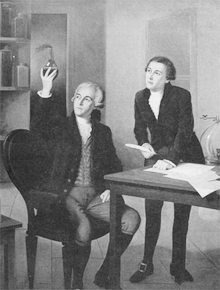
Antonine-Laurent de Lavoisier, and
his student E. I. du Pont, the founder
of DuPont.
the release of an invisible substance called phlogiston, as many believed, but a chemical reaction involving oxygen.
The discovery changed everything.
For the first time, chemistry began evolving from a collection of observations, recipes, and speculation into a predictive science. The conservation of mass, chemical reactions, atomic theory, and eventually the Periodic Table emerged from this transformation.
The discoveries themselves possessed no commercial value.
No one could own the law of conservation of mass.
No one could patent oxygen.
No one could monopolize the Periodic Table.
Yet these discoveries revealed hidden rules governing matter itself.
Once those rules became known, civilization gained the ability to create entirely new materials, processes, and industries.
The consequences were extraordinary.
In 1800, only a small number of chemical compounds were known. Today, millions of compounds have been identified and countless others have been synthesized. Entire industries emerged from humanity’s growing understanding of chemical reactions, atomic structure, and molecular behavior. Fertilizers transformed agriculture. Pharmaceuticals transformed medicine. Synthetic materials transformed manufacturing. Chemical engineering became one of the foundational disciplines of modern industrial society.
The global chemical industry now generates trillions of dollars in annual economic activity.
Yet the original discoveries that made this possible were economically worthless.
A relatively modest investment by the French government to understand the nature of fire ultimately helped create one of the largest technological revolutions in human history.
The pattern did not stop with chemistry.
It repeated itself through the Heat Engine Revolution.
It repeated itself through the Electrification Revolution.
It repeated itself through the Communication Revolution.
It repeated itself through the Digital Revolution.
It repeated itself through the Biotechnology Revolution.
Each began with discoveries that possessed little or no commercial value. Each ultimately generated industries, companies, jobs, technologies, and wealth on a scale that transformed civilization.
The more closely one examines these revolutions, the more difficult it becomes to avoid a simple conclusion.
The true source of long-term economic growth is not technology itself.
Technology is the consequence.
The deeper cause is discovery.
Civilization advances when human imagination successfully uncovers hidden structure within nature and then learns how to exploit that knowledge through invention, innovation, and engineering.
The great technology revolutions were therefore not isolated events. They were manifestations of a deeper process: humanity’s growing ability to systematically interrogate reality itself.
Once this discovery engine emerged and proved successful, technological progress ceased being primarily accidental.
Discovery became cumulative.
Knowledge began compounding across generations.
Civilization accelerated.