The-Countervailing-Obliquity–Precession-Effect
CLIMATE, CIVILIZATION, AND THE DANGEROUS ILLUSION OF CERTAINTY
The legendary writer Stephen King once said:
“Fiction is the truth inside the lie.”
Some stories exist purely to entertain. Others linger because they touch something deeper — a possibility that feels uncomfortably real.
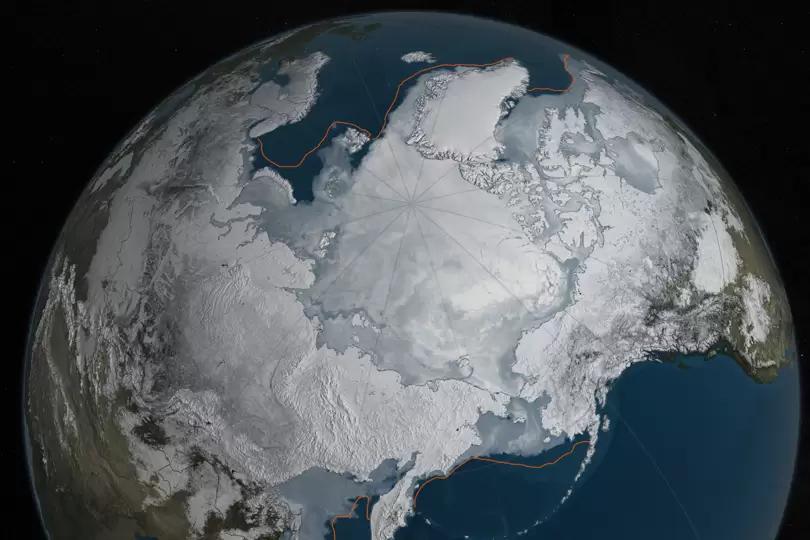
One such story is the television series Snowpiercer. In its frozen dystopian future, a failed attempt to stop global warming accidentally plunges Earth into a new ice age. Civilization collapses. The last survivors circle the planet aboard a perpetually moving train while a brutal new social order emerges inside its steel walls.
At first glance, the premise seems wildly implausible — science fiction at its most extreme.
But hidden inside the fiction is an unsettling truth:
Earth has entered deep ice ages many times before.
And someday, it almost certainly will again.
That is not speculation. It is written directly into the geological history of our planet.
What is remarkable is not that Earth experiences climate change. What is remarkable is how little we truly understand about why the largest climate shifts happen when they do.
For all the confidence surrounding modern climate debates, there remains a sobering reality:
No scientific theory can reliably predict the beginning of the next ice age.
That alone should give us pause.
THE PLANET’S FORGOTTEN HISTORY
You do not need thousands of scientific papers to grasp the broad story of Earth’s climate history. In fact, a few graphs are enough to completely change how one thinks about climate, civilization, and humanity’s future.
Those graphs are built from decades of painstaking scientific work: deep Antarctic and Greenland ice cores, ocean sediment layers, cave deposits, fossil chemistry, and many other sources that allow scientists to reconstruct Earth’s temperatures far into the past.
Taken together, the evidence tells a remarkably consistent story.
Over the last 800,000 years, Earth has repeatedly swung between long frozen periods and relatively brief warm intervals.
And here is the striking part:
The warm world in which human civilization emerged is not the norm.
It is the exception.
For most of recent geological history, Earth has been substantially colder than it is today.
Massive ice sheets once covered large parts of North America and Europe. Sea levels dropped hundreds of feet. Entire ecosystems disappeared or migrated. Regions now home to major cities became nearly uninhabitable.
Modern civilization — with its agriculture, infrastructure, and dense urban populations — developed during an unusually stable warm interval. Human history, in climate terms, has unfolded during a narrow window of relative calm.
We tend to think of our climate as permanent because our lifespans are short.
Geology tells a very different story.
THE RHYTHM OF ICE AGES
The first graph in this climate record stretches back 800,000 years. Temperatures rise sharply, remain warm for a relatively short period, and then descend into long cold intervals lasting tens of thousands of years.
The pattern repeats again and again.
The peaks — warm periods like the one we live in now — are brief interruptions in a much colder planetary story.
Some of these warm intervals lasted only a few thousand years. Others persisted longer. But compared to the immense duration of the ice ages between them, they are short-lived.
The current warm period has already lasted roughly 10,000 years.
That fact naturally raises uncomfortable questions.
Where are we in this cycle?
How stable is the climate we take for granted?
And perhaps most importantly:
What actually causes Earth to shift from warmth into prolonged cooling?
Surprisingly, scientists still do not have complete answers.
THE CLIMATE SYSTEM IS FAR MORE COMPLEX THAN PUBLIC DEBATE SUGGESTS
Public discussion about climate change often creates the impression that the climate system is largely understood and that future temperatures can be forecast with high confidence far into the future.
Reality is far messier.
Climate models are extraordinarily sophisticated tools, but they remain approximations of one of the most complicated systems known to science: a rotating planet with oceans, atmosphere, ice sheets, clouds, vegetation, orbital variations, volcanic activity, and countless interacting feedback loops operating across decades, centuries, and millennia.
Models can simulate many observed trends reasonably well over limited periods. But there is a major distinction between reproducing aspects of recent climate behavior and possessing a complete predictive theory of Earth’s long-term climate evolution.
Ice ages themselves remain only partially understood.
We know orbital variations play an important role. Small changes in Earth’s orbit, axial tilt, and rotational orientation alter how sunlight is distributed across the planet over thousands of years. These cycles influence the growth and melting of massive ice sheets.
But critical questions remain unresolved.
Why do some cooling periods accelerate while others do not?
What triggers rapid transitions?
Why are some warm periods longer than others?
What feedbacks dominate at critical tipping points?
And perhaps most importantly:
Why does Earth eventually emerge from ice ages at all?
The deeper one looks into climate history, the clearer it becomes that Earth’s climate system is governed by enormous nonlinear processes operating over timescales far beyond human experience.
THE TYRANNY OF SHORT TIMESCALES
One reason climate debates become so emotionally charged is that humans naturally interpret the world through short slices of time.
A 30-year warming trend feels permanent.
A few decades of cooling can feel catastrophic.
But paleoclimate records reveal that Earth’s climate contains fluctuations operating on vastly different timescales simultaneously.
The last 150 years, for example, show clear warming trends punctuated by shorter cyclical variations. But when viewed against the backdrop of the last 10,000 years, an entirely different picture emerges: a longer-term cooling trend extending from the peak warmth of the early Holocene.
And when viewed against 800,000 years, even that perspective becomes only a tiny fragment of a vastly larger cycle.
Human beings experience climate through the lens of memory and politics.
The planet operates through physics across immense stretches of time.
Those are not the same thing.
THE REAL DANGER MAY BE CERTAINTY ITSELF
The purpose of recognizing these complexities is not to dismiss climate risks.
Nor is it to claim certainty about future cooling, warming, or catastrophe.
It is the opposite.
The real lesson of Earth’s climate history is humility.
We are dealing with a planetary system that has repeatedly undergone enormous transformations long before industrial civilization existed. A system capable of abrupt shifts, powerful feedbacks, and long cycles that remain only partially understood.
That should encourage deeper scientific curiosity, not ideological rigidity.
Unfortunately, modern public discourse often rewards confidence more than caution. Nuance is interpreted as weakness. Uncertainty is mistaken for ignorance.
But in science, uncertainty is not failure.
It is where discovery begins.
The uncomfortable truth is that civilization depends on a climate system we do not yet fully understand.
And the stakes could hardly be higher.
A future dominated by runaway warming would challenge civilization.
But so would a descent into another major glaciation.
Either possibility reminds us of the same fundamental reality:
Human civilization is far less insulated from nature than we like to believe.
THINKING BEYOND THE HEADLINES
Climate change is often presented as a settled narrative with only one acceptable interpretation.
But Earth’s climate history tells a far richer, more complicated, and more unsettling story.
A story of recurring ice ages.
Of warming peaks that eventually end.
Of immense natural forces operating over thousands of years.
Of feedbacks, thresholds, and uncertainties that science is still trying to understand.
The challenge before humanity is not merely political or technological.
It is intellectual.
Can we think clearly about systems larger than ourselves?
Can we distinguish scientific inquiry from social conformity?
Can we remain open to complexity in a world increasingly addicted to simple answers?
Those questions may ultimately matter as much as the climate itself.