Some stories exist purely to entertain. Others linger because they touch something deeper — a possibility that feels uncomfortably real.
One such story is the television series Snowpiercer. In its frozen dystopian future, a failed attempt to stop global warming accidentally plunges Earth into a new ice age. Civilization collapses. The last survivors circle the planet aboard a perpetually moving train while a brutal new social order emerges inside its steel walls.
At first glance, the premise seems wildly implausible — science fiction at its most extreme.
But hidden inside the fiction is an unsettling truth:
Earth has entered deep ice ages many times before.
And someday, it almost certainly will again.
That is not speculation. It is written directly into the geological history of our planet.
What is remarkable is not that Earth experiences climate change. What is remarkable is how little we truly understand about why the largest climate shifts happen when they do.
For all the confidence surrounding modern climate debates, there remains a sobering reality:
No scientific theory can reliably predict the beginning of the next ice age.
That alone should give us pause.
THE PLANET’S FORGOTTEN HISTORY
You do not need thousands of scientific papers to grasp the broad story of Earth’s climate history. In fact, a few graphs are enough to completely change how one thinks about climate, civilization, and humanity’s future.
Those graphs are built from decades of painstaking scientific work: deep Antarctic and Greenland ice cores, ocean sediment layers, cave deposits, fossil chemistry, and many other sources that allow scientists to reconstruct Earth’s temperatures far into the past.
Taken together, the evidence tells a remarkably consistent story.
Over the last 800,000 years, Earth has repeatedly swung between long frozen periods and relatively brief warm intervals.
And here is the striking part:
The warm world in which human civilization emerged is not the norm.
It is the exception.
For most of recent geological history, Earth has been substantially colder than it is today.
Massive ice sheets once covered large parts of North America and Europe. Sea levels dropped hundreds of feet. Entire ecosystems disappeared or migrated. Regions now home to major cities became nearly uninhabitable.
Modern civilization — with its agriculture, infrastructure, and dense urban populations — developed during an unusually stable warm interval. Human history, in climate terms, has unfolded during a narrow window of relative calm.
We tend to think of our climate as permanent because our lifespans are short.
Geology tells a very different story.
THE RHYTHM OF ICE AGES
The first graph in this climate record stretches back 800,000 years. Temperatures rise sharply, remain warm for a relatively short period, and then descend into long cold intervals lasting tens of thousands of years.
The pattern repeats again and again.
The peaks — warm periods like the one we live in now — are brief interruptions in a much colder planetary story.
Some of these warm intervals lasted only a few thousand years. Others persisted longer. But compared to the immense duration of the ice ages between them, they are short-lived.
The current warm period has already lasted roughly 10,000 years.
That fact naturally raises uncomfortable questions.
Where are we in this cycle?
How stable is the climate we take for granted?
And perhaps most importantly:
What actually causes Earth to shift from warmth into prolonged cooling?
Surprisingly, scientists still do not have complete answers.
THE CLIMATE SYSTEM IS FAR MORE COMPLEX THAN PUBLIC DEBATE SUGGESTS
Public discussion about climate change often creates the impression that the climate system is largely understood and that future temperatures can be forecast with high confidence far into the future.
Reality is far messier.
Climate models are extraordinarily sophisticated tools, but they remain approximations of one of the most complicated systems known to science: a rotating planet with oceans, atmosphere, ice sheets, clouds, vegetation, orbital variations, volcanic activity, and countless interacting feedback loops operating across decades, centuries, and millennia.
Models can simulate many observed trends reasonably well over limited periods. But there is a major distinction between reproducing aspects of recent climate behavior and possessing a complete predictive theory of Earth’s long-term climate evolution.
Ice ages themselves remain only partially understood.
We know orbital variations play an important role. Small changes in Earth’s orbit, axial tilt, and rotational orientation alter how sunlight is distributed across the planet over thousands of years. These cycles influence the growth and melting of massive ice sheets.
But critical questions remain unresolved.
Why do some cooling periods accelerate while others do not?
What triggers rapid transitions?
Why are some warm periods longer than others?
What feedbacks dominate at critical tipping points?
And perhaps most importantly:
Why does Earth eventually emerge from ice ages at all?
The deeper one looks into climate history, the clearer it becomes that Earth’s climate system is governed by enormous nonlinear processes operating over timescales far beyond human experience.
THE TYRANNY OF SHORT TIMESCALES
One reason climate debates become so emotionally charged is that humans naturally interpret the world through short slices of time.
A 30-year warming trend feels permanent.
A few decades of cooling can feel catastrophic.
But paleoclimate records reveal that Earth’s climate contains fluctuations operating on vastly different timescales simultaneously.
The last 150 years, for example, show clear warming trends punctuated by shorter cyclical variations. But when viewed against the backdrop of the last 10,000 years, an entirely different picture emerges: a longer-term cooling trend extending from the peak warmth of the early Holocene.
And when viewed against 800,000 years, even that perspective becomes only a tiny fragment of a vastly larger cycle.
Human beings experience climate through the lens of memory and politics.
The planet operates through physics across immense stretches of time.
Those are not the same thing.
THE REAL DANGER MAY BE CERTAINTY ITSELF
The purpose of recognizing these complexities is not to dismiss climate risks.
Nor is it to claim certainty about future cooling, warming, or catastrophe.
It is the opposite.
The real lesson of Earth’s climate history is humility.
We are dealing with a planetary system that has repeatedly undergone enormous transformations long before industrial civilization existed. A system capable of abrupt shifts, powerful feedbacks, and long cycles that remain only partially understood.
That should encourage deeper scientific curiosity, not ideological rigidity.
Unfortunately, modern public discourse often rewards confidence more than caution. Nuance is interpreted as weakness. Uncertainty is mistaken for ignorance.
But in science, uncertainty is not failure.
It is where discovery begins.
The uncomfortable truth is that civilization depends on a climate system we do not yet fully understand.
And the stakes could hardly be higher.
A future dominated by runaway warming would challenge civilization.
But so would a descent into another major glaciation.
Either possibility reminds us of the same fundamental reality:
Human civilization is far less insulated from nature than we like to believe.
THINKING BEYOND THE HEADLINES
Climate change is often presented as a settled narrative with only one acceptable interpretation.
But Earth’s climate history tells a far richer, more complicated, and more unsettling story.
A story of recurring ice ages.
Of warming peaks that eventually end.
Of immense natural forces operating over thousands of years.
Of feedbacks, thresholds, and uncertainties that science is still trying to understand.
The challenge before humanity is not merely political or technological.
It is intellectual.
Can we think clearly about systems larger than ourselves?
Can we distinguish scientific inquiry from social conformity?
Can we remain open to complexity in a world increasingly addicted to simple answers?
Those questions may ultimately matter as much as the climate itself.
One morning in the not-too-distant future, Americans will wake up to a headline that changes the psychological balance of the world:
China’s economy is now larger than that of the United States.
When that day arrives, politicians will scramble to explain what happened. Economists will debate statistics. Cable news networks will erupt into patriotic outrage.
But the real answer will be painfully simple.
This did not happen overnight.
It happened slowly, over half a century, while America systematically reduced investment in the one thing that historically made it powerful:
Discovery.
Not consumption.
Not financial engineering.
Not political redistribution.
Not government dependency.
Discovery.
The rise of the United States was not an accident of history. It was the consequence of a culture willing to take extraordinary risks — scientific, technological, industrial, and economic. America became the dominant power of the modern world because it repeatedly created entirely new industries and technologies that did not previously exist.
Now we are drifting away from the very engine that created our prosperity.
And China has noticed.
THE MOST IMPORTANT COMPETITION IN THE WORLD
Before the pandemic, China’s economy was growing at more than twice the rate of the United States. Even with fluctuations and slowdowns, the long-term trajectory remains unmistakable.
China is not merely trying to become wealthier.
It is trying to become the world’s central economic and technological power.
And ironically, the United States has spent decades helping it happen.
American corporations transferred manufacturing capability abroad in pursuit of lower costs. Proven business models migrated overseas. Advanced technologies flowed outward. American universities trained enormous numbers of foreign scientists and engineers. Entire supply chains gradually moved beyond U.S. control.
At the same time, the United States began consuming the wealth generated by earlier generations rather than replenishing the source of that wealth.
We became increasingly focused on preserving the present instead of creating the future.
That cultural shift may prove far more important than any individual economic policy.
THE GREAT AMERICAN TRANSFORMATION: FROM BOLDNESS TO INCREMENTALISM
Think about the America of the mid-20th century.
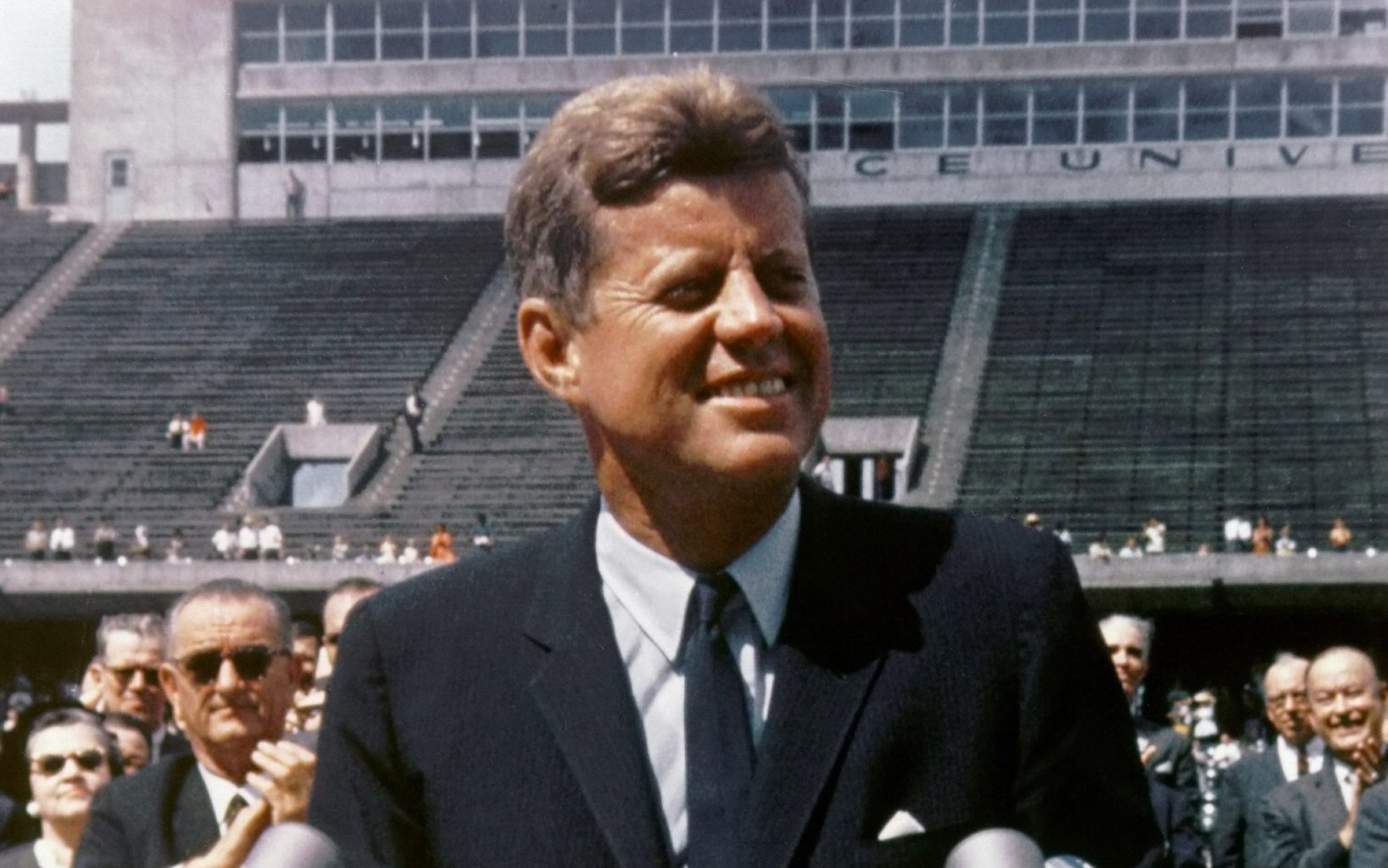
In 1961, President John F. Kennedy announced that the United States would send humans to the Moon before the decade ended.
At the time, this goal bordered on insanity.
The necessary technologies barely existed. The risks were enormous. Failure was possible — even likely.
Yet America did it.
That achievement was not merely about space exploration. It reflected a national culture willing to attempt things that seemed impossible.
Now compare that spirit to much of modern America.
Today, we optimize apps.
We improve advertising algorithms.
We create faster methods for delivering consumer convenience.
We celebrate quarterly earnings while underinvesting in the scientific foundations that generate entirely new technological revolutions.
Our culture increasingly rewards risk avoidance over bold creation.
One can even see this psychology in popular business culture. Watch the television show Shark Tank and listen carefully to the questions investors ask entrepreneurs:
Is the product patented?
How quickly can I recover my investment?
What is the market size?
Who are the competitors?
What are current revenues?
These are not fundamentally questions about creating the future.
They are questions about minimizing risk.
The private sector, contrary to popular mythology, is inherently conservative when confronting deep uncertainty. Businesses are usually willing to fund improvements to proven technologies — not the dangerous, expensive process of pushing beyond the frontier of knowledge itself.
That frontier has historically depended on something else:
Long-term public investment in discovery-based research.
THE SECRET OF AMERICAN POWER
The most important economic story in modern history is not widely understood.
After World War II, the United States dramatically increased federal investment in research and development. The nation invested heavily in science, engineering, mathematics, higher education, laboratories, and advanced technology programs.
Those investments transformed civilization.
The modern computer revolution.
Semiconductors.
Satellites.
Jet aviation.
Nuclear power.
Modern telecommunications.
Biotechnology.
The internet.
Advanced materials.
Space systems.
Virtually every major technological revolution of the last century traces back, directly or indirectly, to sustained investments in scientific discovery and high-risk research.
The truly important point is this:
Scientific discoveries themselves often have no immediate market value.
You cannot easily assign a price to Maxwell’s equations, quantum mechanics, relativity, DNA structure, or semiconductor physics at the moment of discovery.
Yet those “worthless” discoveries eventually created trillions of dollars of global wealth.
This is the great paradox of economic growth:
Civilizations become wealthy by investing in things whose value is initially unknown.
America once understood this deeply.
Now we increasingly behave as though prosperity comes primarily from redistribution, consumption, financial manipulation, or debt expansion.
History suggests otherwise.
THE DANGEROUS DECLINE OF DISCOVERY INVESTMENT
Despite the astonishing success of the postwar research model, federal research and development investment relative to GDP has declined dramatically since the 1960s.
This decline matters more than most people realize.
Because research investment is not simply spending.
It is civilization planting seeds for industries that do not yet exist.
A nation that underinvests in discovery eventually begins consuming the technological inheritance of earlier generations.
For a while, this feels sustainable.
Then growth slows.
Productivity weakens.
Infrastructure ages.
Innovation becomes incremental.
And competitors begin catching up.
That is precisely where the United States now finds itself.
Meanwhile, China is pursuing long-term strategic positioning across advanced manufacturing, artificial intelligence, energy systems, quantum technologies, biotechnology, rare earth minerals, and next-generation infrastructure.
China understands something many Americans have forgotten:
Technological leadership is not permanent.
It must be continuously recreated.
THE POLITICAL PROBLEM NO ONE WANTS TO DISCUSS
There is a deeper structural problem beneath all of this.
Politicians naturally prioritize short-term political rewards over long-term national capability.
A government program that sends checks to voters produces immediate political benefits.
A discovery-based research program may take 10, 20, or 30 years before its economic consequences become obvious.
But by then, the politicians who funded it are long gone.
As a result, democratic systems often drift toward present consumption at the expense of future creation.
This is not merely a budget problem.
It is a civilization problem.
The United States increasingly spends enormous sums addressing immediate needs while underinvesting in the engines of long-term growth.
We are financing the present by quietly borrowing from the future.
THE REAL QUESTION IS NOT ABOUT CHINA
The deeper issue is not whether China rises.
Great powers rise and fall throughout history.
The real question is whether America still possesses the cultural confidence required to create the future rather than merely react to it.
Do we still believe in discovery?
Do we still value scientific ambition?
Do we still have the patience to invest in breakthroughs whose value cannot yet be measured?
Or have we become a civilization focused primarily on consumption, risk minimization, and political theater?
These questions matter because economic growth is not magic.
It emerges from human imagination applied through science, engineering, and technology over long periods of time.
That process cannot simply be wished into existence.
THE FUTURE IS STILL A CHOICE
The situation is not hopeless.
The United States still possesses extraordinary universities, laboratories, entrepreneurs, engineers, scientists, and creative talent. It remains one of the most innovative societies in human history.
But maintaining leadership requires remembering what created that leadership in the first place.
Prosperity does not come primarily from redistributing existing wealth.
It comes from creating entirely new forms of wealth.
That requires investment in discovery.
It requires long-term thinking.
It requires tolerance for uncertainty and failure.
And above all, it requires a civilization willing to believe that the future can be fundamentally different from the present.
The nations that shape the future will not necessarily be the ones that spend the most.
They will be the ones most willing to discover what does not yet exist.
There was once a time when America believed it could do almost anything.
Not metaphorically.
Literally.
It could split the atom, defeat fascism, build entire industries from scratch, cure diseases, walk on the Moon, and reinvent the modern world in the span of a single generation.
That confidence was not arrogance. It was culture. A national culture built around risk-taking, exploration, scientific ambition, and belief in the future.
Today, much of that spirit feels strangely distant. Something fundamental has changed in America — not merely politically or economically, but psychologically. We increasingly live in a culture more concerned with avoiding failure than achieving greatness. And that transformation may be the most important story in America’s long-term decline.
THE SUMMER THAT CAPTURED AMERICA
In the summer of 1969, two extraordinary events occurred only weeks apart.
One was meticulously planned over nearly a decade. The other was almost entirely improvised. One involved rockets, computers, and engineering precision at the limits of human capability. The other involved music, mud, chaos, idealism, and nearly half a million young people gathering on a farm in upstate New York.
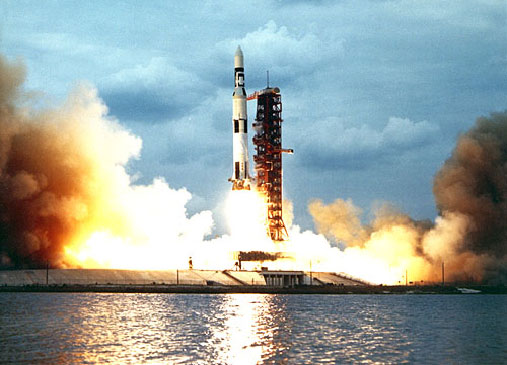
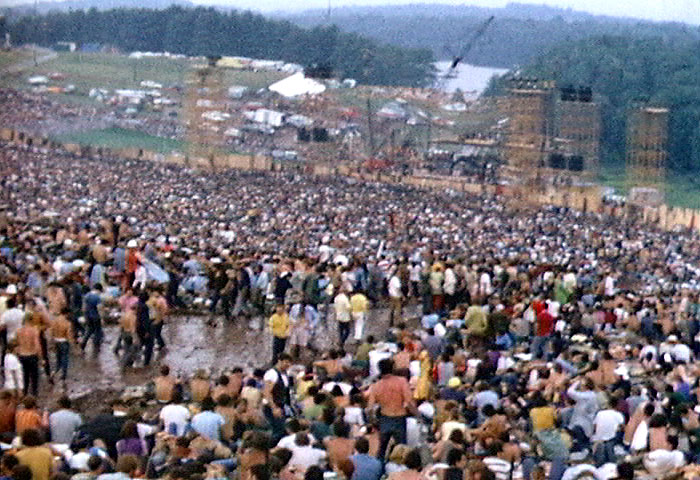
One was Apollo 11 Moon Landing. The other was the Woodstock festival.
The most powerful rocket ever developed, producing 160 million horsepower that shook the ground 3 miles awayA half of million peaceful music lovers on Max Yasgur’s dairy farm in Bethel, NY
At first glance, they seem unrelated. But both reflected something profound about the American spirit at that time: A willingness to attempt things that appeared impossible.
President John F. Kennedy captured that spirit when he challenged the nation to land a human being on the Moon and return him safely to Earth before the decade ended.
At the time, the goal bordered on science fiction. The technologies barely existed. Failure was a real possibility. Yet America pursued it anyway.
That culture believed the future was something to be created — not merely managed.
THE CULTURE THAT BUILT MODERN AMERICA
The rise of the United States was not simply the result of capitalism, geography, or military strength. It was driven by a deeper cultural force: A civilization willing to invest enormous resources into discovering what it did not yet know. That distinction matters.
The modern world was not created primarily by optimizing existing knowledge. It was created by expanding the boundaries of knowledge itself. Electricity. Quantum mechanics. Semiconductors. Nuclear energy. Computers. Lasers. Space systems. Biotechnology. The internet. Artificial intelligence.
These revolutions did not emerge from cautious short-term thinking. They arose from decades of scientific exploration, failed experiments, uncertainty, and sustained investment in ideas whose practical value was initially unknown.
The truly important discoveries in history often looked economically useless when they first appeared. Maxwell’s equations did not come with a business model. Neither did quantum mechanics. Nor relativity. Nor the structure of DNA.
Yet those discoveries eventually transformed civilization and created trillions of dollars in economic value. This is one of the great paradoxes of human progress:
The most economically valuable discoveries are often impossible to value when they are first made.
WHEN AMERICA INVESTED IN THE UNKNOWN
Following World War II, the United States entered one of the greatest periods of scientific and technological expansion in human history. The federal government invested heavily in research laboratories, universities, engineering programs, scientific infrastructure, and frontier technologies.
The results reshaped civilization. The transistor. Satellite communications. The laser.Modern computing. GPS. MRI. Genetic engineering. Supercomputers. Information theory. Advanced materials. The foundations of artificial intelligence.
Many of the technologies we now take for granted emerged directly or indirectly from that era of discovery-driven investment.
America did not become the world’s dominant economic power by accident. It became powerful because it created the future faster than other nations.
THE GREAT CULTURAL REVERSAL
But over time, America began changing.
Slowly, almost invisibly, the national mindset shifted away from bold exploration and toward risk minimization. We became increasingly obsessed with efficiency, quarterly earnings, financial optimization, and short-term return on investment.
Discovery became secondary. Exploration became harder to justify. Long-term thinking gave way to immediate metrics. Even our language changed.
We now celebrate “disruption,” but much of what passes for disruption today is incremental improvement wrapped in marketing language. Faster apps. More targeted advertising. Slightly improved consumer convenience.
Meanwhile, the great frontier institutions that once shaped the modern world have either disappeared or dramatically changed character.
At their peak, companies like Bell Labs, Texas Instruments, Xerox, Hewlett-Packard, and Intel maintained extraordinary research cultures that competed intellectually with the world’s best universities. Bell Labs alone helped produce the transistor, information theory, radio astronomy, Unix, the C programming language, and discoveries that earned multiple Nobel Prizes.
Those institutions were driven by leaders who understood that scientific exploration itself was strategically valuable. Today, many corporations focus overwhelmingly on quarterly earnings and shareholder optimization. Research divisions shrink. Long-horizon projects disappear.
And young people increasingly turn away from careers in science and engineering because the culture no longer visibly celebrates exploration the way it once did.
THE SHARK TANK MINDSET
One can actually watch this cultural transformation unfold on modern television.
Consider the popular program Shark Tank. Entrepreneurs pitch business ideas while wealthy investors rapidly interrogate them: What are the margins? How fast can I recover my investment? Who are the competitors? How much revenue already exists? Can the risk be minimized?
These questions are perfectly rational from a business perspective. But they reveal something deeper about modern culture. Almost all the attention is focused downstream — on monetizing known ideas rather than discovering fundamentally new ones.
The private sector, despite popular mythology, is usually highly conservative when confronting true uncertainty. As Leonardo da Vinci observed centuries ago:
“He who possesses most must be most afraid of loss.”
The pursuit of scientific discovery operates very differently. Discovery is inherently inefficient. Researchers often do not know what they will find.
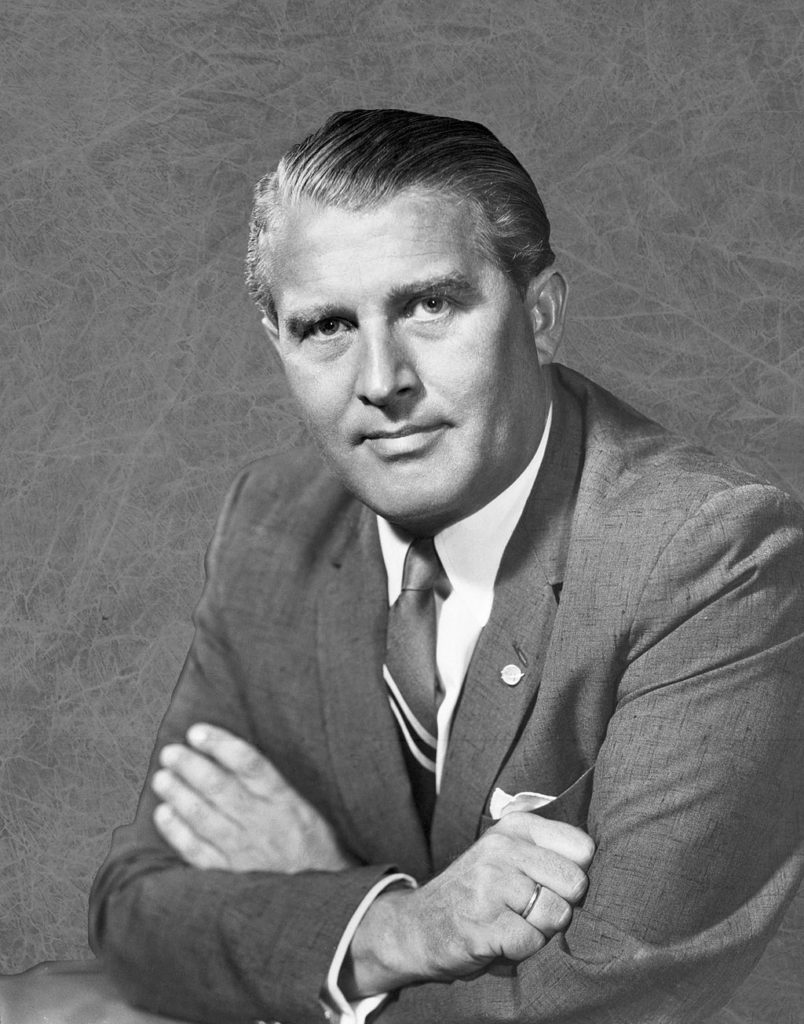
Wernher von Braun, one of the key NASA strategic thinkers for the US space program
As rocket engineer Wernher von Braun once famously joked:
“Research is what I’m doing when I don’t know what I’m doing.”
And yet civilization advances precisely because some societies are willing to tolerate that uncertainty.
THE MOST IMPORTANT CONFLICT IN MODERN SOCIETY
Beneath all of this lies a deeper struggle between two competing cultural systems.
One culture prioritizes exploration, discovery, and long-term creation. The other prioritizes efficiency, predictability, and short-term extraction. One asks: What can humanity become?The other asks: What is the safest return on investment? Both are necessary to some degree.
But history shows that civilizations decline when they become dominated by the second mindset while neglecting the first. Because eventually, optimization runs out of things to optimize. A society cannot endlessly improve existing technologies without replenishing the wellspring of discovery beneath them.
At some point, civilization must again venture into the unknown.
WHAT MADE AMERICA EXCEPTIONAL
For those who lived through the 1950s, 1960s, and 1970s, the cultural contrast is impossible to ignore.
America once projected confidence, ambition, and intellectual fearlessness. It believed the future could be radically different from the present.
Now much of the nation seems psychologically exhausted — more comfortable recycling old ideas than creating new ones.
We even speak nostalgically about “returning to the Moon,” not because it advances civilization in the same revolutionary way it once did, but because we long to recover the spirit that made such achievements possible in the first place.
That is the deeper issue.
The Moon landing mattered not only because humans reached the Moon. It mattered because it revealed what kind of civilization America believed itself to be.
THE FUTURE WILL BELONG TO CULTURES THAT STILL DARE TO EXPLORE
The greatest danger facing America is not merely economic competition, political polarization, or foreign rivals.
It is cultural stagnation. A civilization that loses faith in discovery eventually loses the ability to create the future.
The societies that lead the next century will not necessarily be the largest or wealthiest. They will be the ones most willing to invest in uncertainty. In science. In engineering. In exploration. In imagination. In young minds willing to venture beyond the known frontier.
Human progress has always depended on civilizations courageous enough to pursue truths whose value could not yet be measured. America once understood that better than any nation on Earth.
The question now is whether it still does.
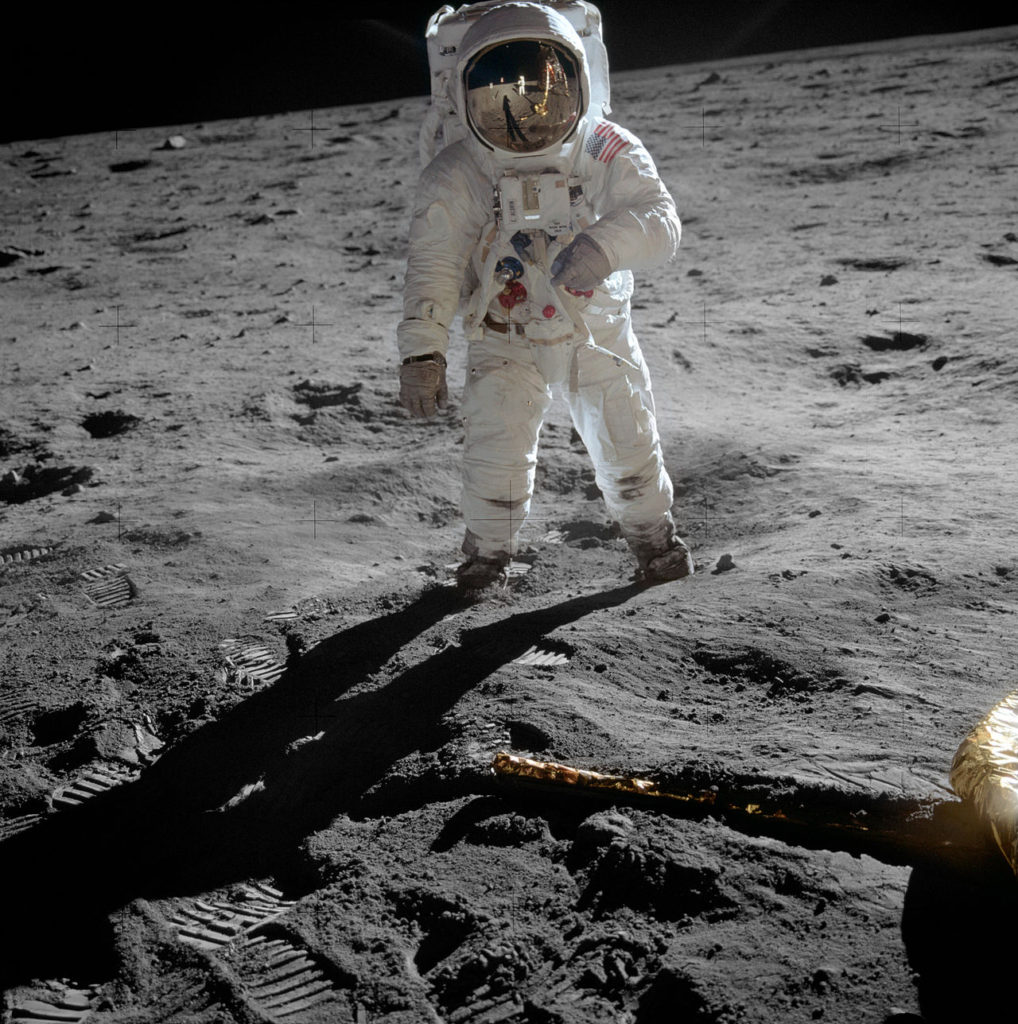
Buzz Aldrin on the moon as photographed by Neil Armstrong, the first human to step on the moon
“The mediocre teacher tells. The good teacher explains. The superior teacher demonstrates. The great teacher inspires.”
William Arthur Ward
The cause of the problem
We all want our children to live fulfilling lives. We want them to realize their dreams of a better future for themselves, their families, and our nation. However, to accomplish these goals, we must provide them with opportunities that can enable them to create their future. The key factor that will limit their ability to create their future is the severe decline in the quality of our K-12 education system, especially the teaching of science, technology, engineering, and mathematics (STEM) subjects. This decline has affected the preparedness of our young people to adapt to a continuously changing and highly competitive world. By allowing this to happen over time, we have put their future and our nation’s future at significant risk.
The decline in our K-12 education system began in the early 1980s. The fundamental cause dates back to university policies that transformed the teaching of STEM courses to aspiring STEM teachers that had little connection to the traditional departments that teach these subjects. This transformation created separate courses such as physics for poets, chemistry for poets, biology for poets, etc., which did not include mathematics in the teaching of these subjects. If a teacher has not struggled with the conceptual problems in learning these subjects, it is virtually impossible to teach them to students effectively. How this training could be effective in inspiring and educating our youth in these fields is incomprehensible.
Our young people are not stupid. They sense when a teacher does not understand a subject and are uninspired by teachers who do not have a passion for the subjects they teach. Today, the majority of K-12 STEM teachers believe their responsibility is to provide students with information. This approach is not teaching. Today, many K-12 STEM teachers fulfill their lesson requirements by primarily reading from scripts. The proficiency of these teachers is so low that it would not take much to replace them with technology, which is a subject that I will return to later.
This transformation in the training of teachers increased university enrollments and, along with it, revenue, which satisfied administrators; however, it also dramatically increased the number of poorly trained STEM teachers. Over the decades, this form of training flooded our K-12 school system with incompetent teachers. Labor unions and school administrators now protect these teachers. Both university presidents and teacher unions have literally wasted our youth in the name of revenue and job security. There may have been good financial reasons to adopt these policies at the time, such as the need for increased revenues during an economic downturn. However, our nation is paying a considerable price in terms of a future workforce ill-equipped to compete in a highly competitive high-tech world.
Our nation led the digital, communication, and biotechnology revolutions. Yet, we lack enough qualified US citizens to compete for jobs in these industries. Ironically, we now have to import expertise to fill these jobs, which our government has enabled through special immigration programs. Such a strategy takes pressure off our K-12 education system to improve STEM education standards.
This circumstance affects our people over the long-term, especially in a world that puts increasing emphasis on STEM skills in numerous occupations. Unless this trend is abated, our education system will create a permanent underclass in our nation that will become increasingly dependent upon public assistance for their survival.
There is now a call by certain politicians to increase public school teacher salaries as if this is a solution to the poor quality of our K-12 education system. Such salary increases could indeed attract those who typically go into STEM-related industries; however, to be effective, the proficiency standards of STEM teachers would have to change significantly. This expedient salary approach to fixing this serious problem is a sinister way that politicians use taxpayer dollars to secure more votes by pandering to the public. These are the same politicians who protect incompetent teachers through their support of teacher unions instead of focusing their attention on protecting the future of our youth and our nation.
Basic facts and consequences
By far, the most important educational challenge we face as a nation is to realize a K-12 educational system that prepares our youth for the future. Our young people will have to be at least as creative and productive as those that will be retiring over the next several decades. Through the skills they develop, the new knowledge they acquire, and the talents they bring to our national enterprise, their future will be our nation’s future.
As obvious as this sounds, we are a nation that spends less time thinking, planning, and investing in our future, especially human potential that inevitably drives everything in our national enterprise. As the challenge of adequately preparing our youth becomes dire, people will focus more on quick fixes. Rather than pursue productive social pathways for themselves, our youth will find government subsistence a more attractive option. Such a path will inevitably result in a public that is no longer in control of their destiny but controlled instead by a massive government bureaucracy.
The list of educational reform proposals and policies for our K-12 system is quite long. Still, none address the fundamental problem of educating our youth in a rapidly evolving world that is increasingly dependent on mastering STEM subjects. It’s not a matter of everyone becoming a scientist, engineer, or mathematician. Science and technology are transforming everything we do through their incorporation into the numerous processes and services we use daily. Failing to keep up with the latest technology improvements could mean the end of a business or job. It could also mean failure to defend our nation against future threats. To meet the challenges of an uncertain future, we need a workforce that embraces science and technology instead of one that fears or avoids it.
Unfortunately, our culture has changed as a result of a series of decisions made over 50 years. As discussed earlier, some of this has to do with the systematic decline in federal government R&D spending as a percentage of GDP by 65 percent since 1965. Concurrently, research jobs in the private sector have largely disappeared. These trends have sent a message throughout our educational system that careers in advancing science and technology through research are not as important as they once were. Making matters worse, qualified STEM teachers are in short supply primarily because they are inadequately trained, and those who are knowledgeable in STEM fields can find better-paying jobs. Exacerbating this situation is a lack of strong dynamic leadership with a vision that can lead our educational system to adopt new standards and methods of teaching to meet the challenges of the 21st century. Until government policies and educational leadership change, there will be little, if any, progress in improving our K-12 education system.
There are about sixty million young people in K-12 education, with about 10 percent in private schools. The case is often made that private schools are less costly per student ompared to public schools. This claim is valid for religious-based private schools. For non-sectarian schools, the cost per student is more than twice that of other private and public schools. Even if private schools were superior educational institutions, not everyone wants to send their child to a religious school, and the vast number of American families cannot afford to send their children to non-sectarian private schools. Therefore, private schools are largely irrelevant to educating the vast majority of our precious youth.
Many complain that the federal government spends too much money on education. This claim was never true. Local governments have primarily supported education throughout US history. There have been short-term blips where the federal government increased education spending after WWII through the GI Bill and during the1960s with President Kennedy’s initiative to expand the accessibility of education to people from all walks of life. However, the federal government has generally been a minor player, while local and state governments have predominantly funded education.
Local governments have created disparities in the quality of education through local real estate taxes. If there is a reason for gross inequities in our educational system, this is it. Families that live in wealthier neighborhoods receive a better-quality education than those living in impoverished areas. It’s hard to imagine how a strategy like this is of benefit to the entire nation. Education is an investment in our youth, which benefits the whole nation and not just a local community. Just imagine improving the retention level of knowledge and skills of about sixty million young people across the nation by about 20-30 percent. That could have an enormous impact on our future through the sheer number of people and the magnitude of the improvement. Asking the federal government to solve this problem would be a big mistake because the House of Representatives is district-based, and the Senate is state-based. Also, having a highly educated public is more of a threat to politicians than a benefit. As I will discuss later, a more equitable approach to education for our youth can be achieved through technology.
There is the claim that the US spends more on education per student per year than any other nation. This claim depends on how this spending is compared across countries. For example, using a nation’s GDP as the comparative measure of education spending eliminates unstable foreign currency conversion rates to US dollars. It also represents the monetary value of all US goods and services produced, which is a measure of what we can afford to invest in education.
Comparing what we spend on all education as a percentage of our GDP, about 6.4 percent, to that of the 35 countries in the Organization of Economic Cooperation and Development (OECD), implies that we are tied for 5th place with Iceland while the United Kingdom is close behind us in 6th place. New Zealand, The Republic of Korea, Norway, and Israel spend more of their GDP on education. We are below the OECD average for K-12 but place first by substantial margins in post-secondary school education.
In terms of outcomes, if you look at US high school dropout rates from the 1960s to the present, there have been significant reductions across all racial and ethnic groups by about one third relative to their historical levels. Just looking at this alone, one might conclude that there has been significant progress.
However, according to our Nation’s Report Card, the proficiencies of K-12 students in subjects like civics, economics, geography, mathematics, reading, science, technology and engineering literacy, US history and writing are all in steady decline. There is no subject at any grade level, where the percent proficiency of students is 50% or more. Astonishingly, the proficiency percentages range from about 40% down to about 10%, depending on the subject and grade level. And instead of improving from lower to upper grades, the percentages systematically decline in all subjects. You can, of course, question the accuracy of these numbers, how they were measured, differences between schools, and deny that there is even a problem, but the overall trends from year to year should be of considerable concern. Some would call this a crisis in K-12 education.
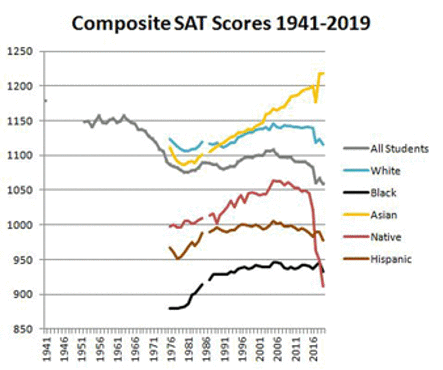
We can gain further insight into this by examining the percentage of high school seniors who met college readiness benchmarks. In 2011, 52% did not meet reading levels. Only 45% were proficient in math and 30% in science. These numbers indicate a significant disconnect in readiness standards between our nation’s high schools and colleges and universities. You can see this in SAT scores over time as indicated in the figure to the left for all students with the exception of Asians. The State of California has decided to solve this problem by eliminating the exams all together. It’s hard to imagine how this helps anyone except those who are doing a very poor job in improving K-12 education. This situation has forced our colleges and universities into providing remedial education in high school subjects. It is not solely a consequence of high school standards, but also the teaching methods and the proficiency of the teachers that teach these subjects. This is irrefutable.
As further evidence, the percentage of students taught by teachers with no major and no certification in core subjects is quite shocking. They range from 30% in math, 61% and 66% in biology and physics, respectively, 79% in earth and space science. Rather large percentages of our youth are being educated by the uneducated. Given these circumstances, it is not difficult to imagine that such teachers fail to inspire confidence or enthusiasm in students that are learning these subjects. It should also be no surprise that less than 15 percent of the top-performing high school seniors major in STEM fields. At this rate, our nation will not meet the future demand for jobs in these fields. Ironically, this situation has required the U.S.to import talent to meet the shortfalls in qualified people for the high-tech sector.
In traveling around the world with about one and a half million miles to my total, once in a while you can get lucky. On a flight from Washington DC to San Diego, I managed to sit next to a former Secretary of Labor. After introducing myself, I mentioned the decline in US citizens going into STEM fields and whether the Labor Department was concerned. To my surprise, I was told there would be plenty of qualified people available through students coming to our nation from outside the US. As is typical, government agencies have narrowly defined policies that serve the purpose of promoting their existence rather than having a coordinated plan across the government that effectively addresses the systemic issues of a significant national problem.
This immigration policy accommodates a K-12 educational system that has failed. It is also creating a permanent underclass of unskilled workers in our nation. Furthermore, this trend will also create a national security risk because U.S. citizens in STEM fields are needed in critical defense areas that require high-level security clearances.
The future of our precious youth has, in effect, become expendable by incompetent teachers, teacher unions, and politicians. When you bring this up with the believers in the system, they simply blame the parents. As a result, we are now in the business of wasting human potential.
An inevitable solution to K-12 education
Solving this problem involves replacing the current system over time with a new paradigm of K-12 education. As typical, any person or organization attempting to change the current system will be confronted by fierce opposition. Any change to the classroom model of teaching, which dates back more than two thousand years to Ancient Greece, is unacceptable. However, absent a radical change in the current system, our future as a nation will very likely provide fewer opportunities for our youth to achieve a fulfilling life in our society.
To start along a path of change, imagine an ideal school for maximizing student performance. Through a carefully crafted selection process, this school would select from a diverse population of students those with comparable learning capabilities. Having students with comparable learning skills enables the training and learning process to be more efficient in maximizing student performance. In contrast, a standard classroom compels a teacher to teach to the middle of the student capability distribution. This conventional approach causes inefficiencies in maximizing student performance on either side of the middle of their learning capability. You lose the students that need more help and those that are more capable of learning become bored.
For such a school, teachers would be required to be proficient in the subjects they teach and have a demonstrated passion for teaching. The school would also have diversity in sports, music, the arts as well as community activities. Students at the appropriate age would be encouraged to participate in school governance to gain an appreciation of leadership. There would also be tests and competitions to measure and promote excellence. Naturally, there would be winners and losers. Through these standards and types of activities, such a school would develop students with strong character and intellectual, emotional, and social intelligence.
There are costly private schools that emulate such a model. Some would object that diversity is limited in such a model because it selects students of comparable learning capability. The problem is that there are inherent limitations of developing individual performance in a standard classroom versus being selective by teaching students of comparable learning capability to maximize their performance. Fortunately, technology can overcome these limitations through the development of human-specific learning and training.
Through the integration of several existing technologies, human-specific training and learning could be made accessible to anyone. This approach would enable each individual to maximize his or her performance at a rate specific to them. With steady advances in AI, machine learning, computer processing, and virtual reality environments, human-specific training and learning will improve. This approach to education would level the playing field by providing equal opportunity for all to obtain a decent education.
For several decades now, we have known that children have a natural affinity for computers and related information-based technologies. We also know that they enjoy single and multiplayer games. These provide risk and reward environments that challenge their skills, both physically and mentally. They are primarily rule-based and role-playing competitions with specific goals that, if achieved, can provide emotional rewards. Realistic graphics supported by a storyline with dynamic visualization can create emotionally exciting immersive environments that engage young people.
We know from Hollywood storytelling that movies that generate emotion are the most memorable. We can recall a movie and even scenes from just recognizing the musical score. We also know that intelligence and emotion are intertwined in the human brain through both behavioral and neurological studies. This fact opens up an opportunity to exploit Hollywood storytelling, realistic graphics, and gaming technology to create learning environments that increase retention through dynamic visualization of stories based on knowledge and communication using spoken language.
This approach requires the introduction of some new elements into traditional pedagogy. These elements involve the integration of Hollywood storytelling, realistic graphics, gaming technology, and critical subject matter concepts that would provide a stimulating and interactive learning and training environment. The system would have a software-driven director and intelligent tutor that assesses individual learning and training proficiency and, if necessary, adjusts the path to proficiency to match the specific individual. Natural language processing and dialog management between the student and the system would be used to enable real-time feedback. Cultural and age-specific differences could also be made a part of the learning and training experience. For STEM subjects, this would have to be supplemented by hands-on training by students conducting actual experiments along with data analysis, so they have a complete experience.
For example, about nineteen years ago, I was tasked by the Army Chief of Staff, General Eric Shinseki, to create a unique STEM competition for our nation that was specific to middle schools. The goal was to make this competition inclusive by engaging students from all backgrounds by focusing on subjects that middle school students thought were cool. In formulating this competition, surveys of seventh- and eighth-grade students and teachers were conducted at several representative schools across the nation to determine age-related student interests. Our work indicated that sports and recreation, environment, health and safety, and arts and entertainment were the dominant areas of interest for seventh and eighth graders. Of course, one might ask: “What do these interests have to do with STEM fields?” The answer is “everything” because STEM fields have played a significant role in creating and advancing these human activities.
This new competition, eCybermission, focused on these principal themes and has been tremendously successful over the last 18 years. Students from all social strata have participated in numerous small teams in all 50 States, US territories and possessions with projects in these four areas. One of these teams even received a national award from the President of the United States. From this competition we learned that age-specific interests could increase relevancy and encourage student interest in STEM subjects.
These features can all be a part of learning and training environments for academic subjects that come alive through virtual reality. Rather than reading about history or listening to it described in a classroom, it can be experienced through storytelling and visualization. Significant events in history, those who made history, battles won and lost, scientific, engineering and mathematics discoveries, and other subjects could all be visualized through a virtual reality environment with an emphasis on when it happened, how it happened, and the lessons learned. Instead of listening to abstract discussions of mathematics and physics in a classroom, these subjects can be presented through an adventure story with challenges that can be solved by employing subject matter rules and principles just like games young people enjoy playing today.
By exploiting artificial intelligence that learns, the training and learning environment can be made adaptive to the characteristics of the student. The system could dynamically adjust by providing alternative learning paths using a set of skill metrics to identify deficiencies during learning and training sessions. Using experts who understand the conceptual and process problems students typically have in these subjects, the learning and training environment can be designed to focus on overcoming these challenges with immediate reinforcement through inspiring messages that acknowledge progress. In this way, the persistence that young people exhibit in playing games can be utilized to win at learning and training.
This approach can be taken one step further through interactive assessments using natural language processing and dialog management, so the student can ask personal performance questions of the system, which can then provide recommendations on ways to improve on the educational experience. In essence, the system would have a built-in intelligent coach. The retention and mastery of a wide range of academic subjects will increase by making the experience of learning and training immersive, emotional, and human-specific. What is more, progress in learning and mastering a subject becomes a more focused and dynamic experience between the immersive environment and the student.
The only limitation to succeeding with this approach will be human imagination in realizing the types and nature of these environments. And the enormous customer base will drive down costs over time to make them affordable. What is more, technology will only improve with time, making the experience more entertaining, realistic, and enjoyable for learning and training.
To develop this system will require leadership that brings together those gifted and talented individuals representing the various disciplines needed to create these environments. Developing this is far from a simple task because of the diverse professional cultures involved and the balancing of inputs to accomplish the goal of creating an effective learning and training environment. However, there are no fundamental obstacles to achieving this.
Like most new ideas, the major obstacle will be the entrenched interests of the status quo. To achieve this will necessarily involve risk-taking and a willingness to oppose a failed educational system, which so many out of complacency depend on for their children. If we do not change our K-12 education system, we will continue to reduce social pathways to the future for our precious youth. Changing this is only a matter of recognizing the urgency, and that urgency is their future and the future of our nation.
We are all looking for an answer to the social disparities in our society. We tend to reduce the issue of racial inequality down to a single number, the percentage of people of some color. It’s simple, so we readily accept it. We then take out our hate of social injustice on police who are of all colors. They are at the end of a terrifying problem: violent crime. Those in law enforcement have to clean up the mess that has been caused by the policies of feckless politicians who have no shame in blaming them for protecting us all from serious crimes.
The truth is that through their ineffective policies, politicians have created a permanent underclass in our society. There are the poor that live in communities riddled with violent crime. There are about 16 million White Americans, 9 million Black Americans, 2 million Asian Americans, and 11 million Hispanic Americans that are poor. Is this inequality a result of racism? This notion makes no sense. To solve this serious societal problem, you cannot focus on one color because the problem is colorless, involving about 40 million human beings. They should all matter to us as caring and compassionate people. Not to do so is a social injustice to our nation’s poor.
If you believe that the greater percentage of African Americans in prison versus White Americans proves we are a racist nation, you still have to explain why there are other races and ethnic groups in prison. There are also more White Americans and Hispanic Americans than African Americans that are poor. By failing to explain these disparities, we have an incomplete and potentially dangerous misconception of what divides us as a nation. The consequences of this lack of understanding have had horrible effects on the destruction of lives and livelihoods, as we can see today. If you devalue the lives of the poor, then that is the way their lives will be treated.
It is a well-established fact that violence and crime are much more prevalent in poor communities. So, could it be that the conditions of poverty and the culture that goes along with it affect the occurrences of arrests and incarcerations? It is known that poverty and its culture are pathogenic. That culture is passed on from generation to generation independent of race. I saw it and experienced it growing up on the streets of the Bronx. This very serious life and death issue should bind us together as a society to do something about it. Instead, because of political opportunity to win votes and improving viewer ratings, this social divide persists and along with it increasing emotional strife.
Some may think this is just an attempt to explain away the deeply held belief that we are a racially divided nation, but you would be turning your back on a much bigger societal problem. Unfortunately, this labeling of racial prejudice has all been reduced to a prevailing narrative that hides what politicians and some in the media do not want to discuss. They do not talk about it because the real issue affects us all and future generations. By discussing it, politicians would lose votes, and the media would lose viewers. These people will exploit any story they can make up to serve their narcissism and lust for control of the way we must think. It all boils down to vested interests and protecting business models that rely on the flow of money. They make a living by getting us to hate each other.
There are common factors that cause social disparities in our nation. I can shed some light on this issue through the experiences of my family, who were immigrants to this country. It’s one of many only in America stories.
My father came to America from a small town outside of Naples, Italy. He was from an impoverished family. They were so poor that my father had his first pair of shoes when he was seven years old. Those shoes were given to him by nuns from a local church. He had a 3rd-grade education and could not read or write; however, as a young man, he learned how to grow flowers, plants, and make floral arrangements from his uncle. This skill would enable him to escape poverty when he came to America. However, that journey to America would involve many risks.
My father was full of ambition. When 21 years of age, he had a strong desire to establish a flower business in his town, but his uncle prevented him from the power he had in the local flower market at the time. So, at the age of 21, he decided to join the Italian Navy. That decision would completely change his life.
During 1928-1930, serving as a sailor on the Italian battleship Libya, my father circumnavigated the world several times. He spent most of his time in Asia, in particular Japan and China. However, he did visit America and many other countries in the Middle East, Africa, and elsewhere. This experience gave him a sense of what the world had to offer. During my childhood, he would tell me many stories in his self-stylized broken English, which you could only understand if you spent time with him. He used words and phrases that, by conventional standards, were incomprehensible. Most people who listened to him thought he was illiterate and stupid. But behind this illiterate façade was someone with ambition and enormous imagination.
Shortly after his time with the Navy, he decided to join the Italian merchant marine because there were no opportunities for him to start a business in his town. He knew from experience that America was the land of opportunity, while Italy in 1930 was the land of fascism and oppression. The availability of opportunity was the key element to my father’s success in America, but it was not all that easy to find.
So, in 1930, he jumped ship and entered the U.S. through Canada as an illegal alien. He resided in the Bronx with a family he knew from his town and assumed their last name. The timing of this transition was far from optimal because of the Great Depression. He struggled, as did many others, during this period with little hope of making a living. I remember as a child finding polished horseshoes in our small apartment in the Bronx that he refurbished and sold as good luck charms.
My father was a very handsome man. He looked like Errol Flynn, the Hollywood actor famous for his role as Robin Hood. Using his good looks, he met a wealthy woman who loaned him some money to start a business. He started a dry goods business in an area of the Bronx called Arthur Avenue, where there was a vibrant Italian community. His small store was very successful, and like all such businesses, he had to pay the local Mafia protection money. If he didn’t, they would shut him down.
His progress came to an end when the U.S. entered WWII. I once found an arrest warrant for him in a shoebox. At the time of WWII, if you were an illegal alien in the U.S., you could be arrested for espionage. My father met with F.B.I. Agents in downtown Manhattan and he explained how he entered the U.S. They believed his story; however, he could only stay in the U.S. if he joined the armed services to support the war effort. My father had two weeks to comply, so he sold his business at a loss to serve in the U.S. Army. This commitment to defend America is how he became a U.S. citizen.
While serving in the U.S. Army, he was injured and given an honorable medical discharge. He never claimed a disability benefit because he felt that others with more severe injuries were much more deserving. Shortly after his discharge, he met my mother through the family he lived with when he came to America. Like my father, my mother was an immigrant to this country from Sicily. She came in 1905 at the age of one and a half years in her mother’s arms through Ellis Island. As a woman in a Sicilian family, she worked most of her life, giving what she earned to her family. She was a seamstress who worked in sub-standard sweatshops for menial wages and made clothing for the rest of her family. She managed to get a 6th-grade education that enabled her to read, write, and do arithmetic. This minimal education became a valuable factor in their lives. When she married my father, she did not even have a nickel to her name. All that she had earned went to her family.
The fact that my mother could read became essential to my father’s search for a job. She found a job listed in a News York newspaper at Judith Garden Flowers in downtown Manhattan. They were looking for a florist to design and produce flower arrangements. So, my father decided to go back to the skills he learned as a young man in Italy. This opportunity changed his life and my mother’s in ways that they could not imagine. He became a well-known Madison Avenue florist. So much so, that he became the personal florist to the Duke of Windsor, decorated the wedding of Elizabeth Taylor to Nicky Hilton, was a florist to many Hollywood Stars, and eventually decorated the White House for President Johnson’s inauguration. He even met President Johnson. Only in America could something like this happen.
Having lived through WWI, the influenza pandemic of 1918, the Great Depression, and WWII, I learned many things from my father. He often told me that if you have no money in America, people will spit on you. This statement captures the plight of the poor. I believe that the memory of being poor was always on his mind. I also think that this horrible memory compelled him to think of new ways to make a buck. My father also told me that without ambition, you could not succeed in life. As he said to me many times, I had a choice of either using my brain or my back. It was up to me. By watching my father make floral arrangements, and being involved in his numerous ideas, I learned the importance of having ideas. As an example, he once told me that he wanted to grow pink pineapples. When I asked him why he said everyone would want to one. He worked on this idea until he was 85 years old. Today it has been accomplished through genetic engineering. This passion for ideas stayed with me throughout my life.
While I was a good student in school and received a decent public school education that was available at that time, I grew up in the northeast Bronx, mainly during the 50s and 60s, when New York street gangs were prevalent. These gangs were a part of folklore passed on by those, like myself, who hung around street corners. Songs, like The Wanderer sung by Dion DiMucci, captured life on those streets through the words:
“Oh well, I roam from town to town I go through life without a care And I’m as happy as a clown I with my two fists of iron and I’m going nowhere“.
Unfortunately, I eventually became a part of this culture. I started with hope and aspirations like most kids, but over time this optimism decayed through self-doubt and the security offered up by a Bronx street gang. This decay eventually immersed me in violence and the dark side of growing up on the streets. My participation in a very serious crime put me in jail. This experience nearly destroyed my life. However, the tragedy of it ignited my spirit and courage to eventually transform my life to one of value to myself and others.
As fate would have it, I managed through redemption and hard work to escape from the streets of the Bronx. I attribute this to the unconditional love of my parents and an unrelenting personal desire to seek meaning in life. I eventually discovered a passion with the help of some teachers. Looking back, the pathway out of what anyone would call a total waste of life was fortuitous. Nevertheless, that path took me on a transformational journey to a doctoral degree in physics from MIT, which provided life-changing opportunities I could never have imagined growing up on the streets. If you were to tell me when I was 17 years old that I would accomplish this, I would have told you that you were out of your mind. Nevertheless, I managed to mentally move from street culture to a highly intellectual one, never feeling completely comfortable with the transition even to this day.
The main lesson from this short essay is that what divides us is the horrible gap between the “haves” and “have nots” and the terrible disparagement that goes along with being poor. It’s a systemic problem that has to do with our values. Without opportunities to create a better pathway through life and a decent education for their children, the poor live in a constant state of despair. Despair and boredom can lead to anger, and anger can lead to violence. We have seen this happen in many third world countries. If our weak and ineffectual politicians would have some courage, instead of pandering for votes, and our storytelling media would focus on facts that could matter in the lives of people, our nation could then concentrate on the challenge of overcoming impoverishment in this country. For example, try providing the youth of the poor with quality education, quality recreational activities that build character and civilized social camaraderie, and a belief in themselves and their God-given abilities. Try that for a start instead of trying to make us hate each other.
I am often reminded of the caring thoughts of John W. Gardner, who dedicated his life to public service, that capture the problem we have,
“We don’t even know what skills may be needed in the years ahead. That is why we must train our young people in the fundamental fields of knowledge, and equip them to understand and cope with change. That is why we must give them the critical qualities of mind and durable qualities of character that will serve them in circumstances we cannot now even predict.”
Politicians could never anticipate a situation like the devastating one caused by an invisible virus. They just do not have that much imagination. Nature, however, is full of surprises simply because of natural random processes that can create unique life forms, which can radically change the future of the entire world. In a sense, it is nature’s way of creative destruction. Changes like this can create unique circumstances for the politically minded to achieve goals that they could not accomplish under normal circumstances.
Looking for an opportunity, politicians are forever vigilant because seizing political power fulfills the needs of their narcissism and self-importance. The extreme left of the Democratic party may have been provided with an extraordinary opportunity to change American society forever with minimal effort. A virus, a thousand times smaller than the width of a human hair, has crippled our society in a way that is causing people to become desperate. Desperation can be measured by the persistent absence of toilet paper, paper towels, and food items that are not perishable. It’s almost like people are anticipating the apocalypse. Given such circumstances and the emotional vulnerabilities that follow, there may be much less for left-leaning Democrats to do to achieve their expansion of taxpayer-funded social programs. If there were ever a free political lunch, this gift from nature to the opportunists is more than they could have expected or anticipated in their lifetimes.
In their typical fashion, the liberal media is using what they call scientific truth (as if they understood what science means) to affect the minds of the public with doom and gloom scenarios and anecdotal evidence of the effects of the disease. The good news stories are rare, but this is business as usual. The public is being given an ultimatum: either stay home until the virus no longer kills anyone or challenge authority by going back to work with the possibility of infection and even worse death to themselves and others. No one objectively understands the correct balance that will save lives and livelihoods. Staying home creates the ideal circumstances for the general public to dig a deeper financial hole for themselves, which incentivizes the need for government subsistence programs. However, the outcome of this strategy is unlikely to restore the nation to normalcy, given the rapidly growing financial obstacles that continue to mount daily. Many jobs and businesses are likely to be permanently lost. At one extreme, Governor Gretchen Wittmer has an executive order that is supposed to keep the residents of Michigan at home until labor-day, with no specific plan to address the potential economic damage to the State and its people.
In November, there is the possibility that the economic situation may be so dire that once again, the American people will want the government to fix this type of problem as they decided in 2008. Expanding central government control of the short-term needs of people is the specialty of the Democrats. Meanwhile, President Trump and Congress have responded to the current circumstances by an unprecedented aid package that is consistent with the political goals of the progressive left. This aid package is enormous, more than 3 trillion dollars or 75% of the total annual federal budget, and of the type that Bernie Sanders and his followers have been anxious to implement for our nation. These policies are part of the liberal progressive narrative and playbook.
While the extreme left has been vocal about expanding government social programs, Nancy Pelosi has resisted their calls for a socialistic agenda for the Democratic party up until recently. That is changing because the circumstances make larger government subsistence packages more acceptable to the general public. She now thinks guaranteed monthly income is worthy of consideration, and she, her staff, and a small group of loyal Democrats have at warped speed jammed another enormous spending bill through the U.S. House of Representatives. This bill, dubiously called the Heroes Act, is filled with typical left-wing policies that, typically, would not be accepted by the public. They somehow expect people to believe that a small group of politicians who understand very little about how the world works could sensibly formulate the spending of $3 trillion in record time. It violates common sense. With help from a virus, this bill will likely seed the growth of socialism in America if passed by Congress and the President.
Currently, Joe Biden is also moving further to the left with proposals such as an expansion of Medicare and the elimination of student debt to help meet the goals of the far left of his party. They expect to provide voters with emotional comfort despite the deteriorating economic circumstances. Concurrently, the big blue States, especially New York, New Jersey, California, and Illinois, are contributing to this through their prolonged lockdowns. In this way, these States are likely to become more desperate, and their economic conditions more irreversible as inaction in opening up their economies takes its devastating financial toll. This evolving Democratic strategy may have a reasonable chance of succeeding in November.
Of course, the Democratic socialists will claim that this is all about saving people. However, the cause of all of this has nothing to do with socialism. It will just be another lie that is intended to hide a political agenda to change American society forever. In support of this goal, Biden and his loyal followers will likely move further to the left to capture Bernie supporters. This political opportunity is about crafting a strategy to seize political power and to change our nation radically. If this strategy succeeds, we can expect from many examples in history that we will go from a country with the potential to lead the world into a mediocre one. We will join the club of average nations. It will not be because the politics of socialism succeeded but rather because of an invisible virus set up the conditions for political opportunists to seize power so that America will never be great again.
In a society driven by markets, prices, profits, and competition, the idea of creating wealth from worthless things sounds absurd.
Yet that is precisely what happened.
The greatest source of wealth and prosperity in human history was economically worthless when it was created and remains unsellable today. This simple observation points to one of the deepest and most overlooked mysteries in economics: What actually caused modern economic growth?
Economists have debated this question for more than two centuries. Since the publication of Adam Smith’s landmark work, The Wealth of Nations, in 1776, scholars have identified many factors associated with prosperity—capital, labor, institutions, entrepreneurship, innovation, education, technology, and markets. Each undoubtedly contributes to economic growth. Yet identifying factors that influence growth is not the same as identifying the original cause.
The distinction is important.
A forest fire depends upon fuel, oxygen, and heat. Remove any one of them and the fire dies. Yet none of these explains what ignited the blaze in the first place.
Economic growth presents a similar challenge. Many forces contribute to prosperity once growth begins. Far fewer explain why civilization suddenly escaped thousands of years of relative stagnation and entered an era of unprecedented technological acceleration.
Something appears to be missing.
If we hope to sustain strong economic growth for future generations, we must first identify its actual cause. Only then can we understand why some societies prosper, why others stagnate, and why periods of extraordinary growth often emerge unexpectedly before transforming the world.
To uncover the answer, we must question several assumptions that have become deeply embedded in how we think about prosperity.
Consider Robert Gordon’s influential book The Rise and Fall of American Growth. Gordon presents a sobering assessment of America’s economic future. He argues that many of the transformative inventions responsible for extraordinary growth between 1870 and 1970 have already occurred. Electrification, urban sanitation, chemicals, pharmaceuticals, the internal combustion engine, aviation, and modern communications fundamentally altered human existence. By comparison, much of modern technological progress appears increasingly incremental.
Gordon’s concern is not difficult to understand. The technologies that transformed civilization during the twentieth century emerged from a remarkable period of invention and discovery. If comparable breakthroughs fail to appear in the future, economic growth may slow substantially or even stagnate.
Yet Gordon’s analysis raises an important question.
If electrification, transportation systems, pharmaceuticals, telecommunications, and computing created extraordinary prosperity, what created them?
Technology undoubtedly contributes to economic growth. But technology itself must first be created. Before asking how technology produces prosperity, we must ask what produced the technology.
Thomas Friedman’s The World Is Flat examines a different challenge. Friedman argues that globalization and modern communications have dramatically reduced traditional competitive advantages. Once knowledge is demonstrated anywhere in the world, it can often be replicated elsewhere with astonishing speed.
This observation points to another important reality. Innovation is becoming increasingly difficult to protect. Knowledge spreads rapidly. Competitors emerge quickly. The time required to recover investments often shrinks.
Yet here again we encounter a deeper question.
Innovation transforms inventions into practical products and services. But what created the inventions in the first place?
Technology cannot explain its own origin. Innovation cannot explain its own origin. Both depend upon something that came before them.
These works identify important trends that may shape future prosperity. They help explain why growth may accelerate or slow. Yet neither fully resolves the deeper mystery concerning the original source of civilization’s extraordinary technological acceleration.
The market value of companies today is largely determined by intangible assets.
Among economists, perhaps the closest approach to this mystery comes from the work of Nobel Prize-winning economist Paul Romer.
As David Warsh describes in Knowledge and the Wealth of Nations, Romer recognized that traditional economic models were overlooking something important. Economic growth appeared increasingly tied to intangible assets rather than merely physical ones.
Knowledge matters.
Patents matter.
Research and development matter.
Scientific understanding matters.
Mathematical algorithms matter.
Human expertise matters.
These forms of knowledge enable organizations to create value far beyond what can be explained by physical assets alone. Today, much of the market value of successful companies resides in intangible assets rather than factories, machinery, or real estate.
Romer’s insight represents an important step forward.
But it still leaves an unanswered question.
What kind of knowledge are we talking about?
Patents possess commercial value because they can be owned. Proprietary algorithms possess commercial value because they can be controlled. Intellectual property possesses commercial value because it can be licensed, transferred, and sold.
Yet the discoveries responsible for many of civilization’s greatest technology revolutions possess a very different character.
Newton’s Laws cannot be patented.
Maxwell’s Equations are not commercial products.
Quantum Mechanics itself cannot be sold.
Calculus cannot be owned.
Unlike intellectual property, discoveries of this type possess no conventional market value. They cannot be replicated in quantity and sold. They cannot be modified to suit individual customers. They cannot be privately owned in any meaningful sense.
Yet their consequences have transformed the world.
This creates one of the deepest paradoxes in economic history.
How did civilization create extraordinary wealth from discoveries that were economically worthless?
The answer requires us to look beyond economics and into the origins of scientific discovery itself.
For most of my career, leading research and technology organizations, I witnessed firsthand how economic performance depends upon the creation, accumulation, and application of knowledge. I also observed a recurring pattern that appeared throughout the history of technological civilization.
The individuals who created the greatest wealth seldom began by trying to create wealth.
Instead, they sought to understand something.
Why do objects fall?
What is fire?
What is heat?
What is electricity?
What causes heredity?
What is light?
What is matter made of?
These questions possessed no obvious commercial value. Yet the answers transformed civilization.
The true trailblazers of modern prosperity often pursued discoveries that seemed economically useless at the time. Like Newton’s Laws and Calculus, the resulting knowledge possessed no conventional market value. Nevertheless, these discoveries expanded humanity’s ability to imagine new possibilities. Through education, they spread across generations. Through engineering, they inspired inventions. Through innovation, they evolved into technologies. Through entrepreneurship and investment, they eventually transformed industries and economies.
The process follows a remarkably consistent pattern.
Discovery inspires invention.
Invention inspires innovation.
Innovation creates technology.
Technology creates industries.
Industries create wealth.
Most economic analysis focuses on the final stages of this chain. Yet the origin of the process lies at the beginning.
Without discovery, nothing follows.
To establish discovery as the true source of technological revolutions, we must examine history itself. If discovery is the cause, we should observe recurring patterns connecting seemingly unrelated people, events, technologies, and industries across centuries. These patterns should repeatedly demonstrate how new scientific knowledge inspired entirely new forms of technological capability.
History reveals precisely such a pattern.
Again and again, civilization advanced when individuals uncovered hidden structures embedded within nature itself. Those discoveries subsequently inspired inventions and technologies that transformed the world.
The pattern appears so frequently that it becomes difficult to dismiss as coincidence.
Consider one of humanity’s oldest mysteries: fire.
For thousands of years, people used fire without understanding what it actually was. Fire cooked food, provided warmth, hardened metals, illuminated darkness, and powered civilization long before anyone could explain its true nature.
Then, during the eighteenth century, a remarkable transformation occurred.
Through the work of Antoine-Laurent de Lavoisier and others, the mystery of fire began to yield to systematic investigation. Careful experiments revealed that combustion was not
the release of an invisible substance called phlogiston, as many believed, but a chemical reaction involving oxygen.
The discovery changed everything.
For the first time, chemistry began evolving from a collection of observations, recipes, and speculation into a predictive science. The conservation of mass, chemical reactions, atomic theory, and eventually the Periodic Table emerged from this transformation.
The discoveries themselves possessed no commercial value.
No one could own the law of conservation of mass.
No one could patent oxygen.
No one could monopolize the Periodic Table.
Yet these discoveries revealed hidden rules governing matter itself.
Once those rules became known, civilization gained the ability to create entirely new materials, processes, and industries.
The consequences were extraordinary.
In 1800, only a small number of chemical compounds were known. Today, millions of compounds have been identified and countless others have been synthesized. Entire industries emerged from humanity’s growing understanding of chemical reactions, atomic structure, and molecular behavior. Fertilizers transformed agriculture. Pharmaceuticals transformed medicine. Synthetic materials transformed manufacturing. Chemical engineering became one of the foundational disciplines of modern industrial society.
The global chemical industry now generates trillions of dollars in annual economic activity.
Yet the original discoveries that made this possible were economically worthless.
A relatively modest investment by the French government to understand the nature of fire ultimately helped create one of the largest technological revolutions in human history.
The pattern did not stop with chemistry.
It repeated itself through the Heat Engine Revolution.
It repeated itself through the Electrification Revolution.
It repeated itself through the Communication Revolution.
It repeated itself through the Digital Revolution.
It repeated itself through the Biotechnology Revolution.
Each began with discoveries that possessed little or no commercial value. Each ultimately generated industries, companies, jobs, technologies, and wealth on a scale that transformed civilization.
The more closely one examines these revolutions, the more difficult it becomes to avoid a simple conclusion.
The true source of long-term economic growth is not technology itself.
Technology is the consequence.
The deeper cause is discovery.
Civilization advances when human imagination successfully uncovers hidden structure within nature and then learns how to exploit that knowledge through invention, innovation, and engineering.
The great technology revolutions were therefore not isolated events. They were manifestations of a deeper process: humanity’s growing ability to systematically interrogate reality itself.
Once this discovery engine emerged and proved successful, technological progress ceased being primarily accidental.
I presented this talk at the MIT Physics Colloquium on September 5th, 2019, which concerns a critical human need, economic growth. It is, in large part, a brief description of some of human history, but not one we learn in history class. In this talk, I identify the cause of economic growth and how this cause created technology revolutions.
Such revolutions fueled extraordinary wealth creation and increased the standard of living by more than 3000 percent over the last 200 years. This same cause also enabled the U.S. to become a world economic and military power after World War II.
Unfortunately, over the last half-century, the role this cause has played in creating opportunities for economic growth has been reduced by 65% as a result of social and political forces, which have directly affected U.S. government funding policies.
This situation raises serious concerns about our ability to create our economic future. If you care about your children’s future, the future of their children, and the future of this great nation, then this talk will provide you with knowledge and a plan as to how we can ensure that prosperity for all can continue for future generations.